Foundations of Coherence
A Practical Philosophy for Aligning Strategy, Capabilities and Execution
An Essay on Organizational Coherence
A practical philosophy for aligning strategy, capabilities and execution
Preface
I did not arrive at these ideas through observation alone.
I arrived at them through a specific experience that took me years to interpret correctly — and through the recognition that what I had built, and what had failed, were not the same thing.
For several years, I built a company called GliadinaFree around a single organizing principle: that the value proposition was not a marketing message. It was the condition for every internal decision. Every process, every product choice, every operational investment existed in service of one specific promise to one specific customer.
By that measure, the company was coherent.
What I did not see at the time was that coherence had become a source of stability — and that stability had quietly replaced the urgency to grow. The promise and the operation were aligned. That alignment felt like maturity. It was not. It was equilibrium mistaken for progress.
What I once understood as coherence — alignment between promise and execution — I now understand as something more unstable and more demanding. Coherence is not a state. It is a dynamic condition that must be continuously earned, especially under the pressure of growth.
I learned this, in part, through what the data eventually showed. When we finally invested in commercial capability with the urgency it deserved, the e-commerce channel grew 270% in twelve months. The architecture worked. The promise was real. What had been missing was not coherence — it was the willingness to expand it.
The company did not survive. The reasons were multiple and interconnected: insufficient commercial structure, partners learning through avoidable mistakes, investors without the patience the model required. I carry my share of that responsibility. There were moments when I should have been more decisive — more willing to impose direction rather than defer to a process of collective learning that cost us time we did not have.
But the interpretation I want to offer here is not one of failure. It is one of incompleteness.
What I had built was not a failure of coherence. It was a failure to recognize that coherence operates on more than one cycle — and that these cycles do not fail in the same way, or at the same speed.
That distinction is where this essay begins.
What I once treated as a single problem — how to align an organization around a promise — I now understand as two interdependent problems. The first is architectural: how to design an organization around a promise clearly enough that every capability, process and decision reflects it. The second is dynamic: how to ensure that the organization continues learning from the consequences of keeping that promise — and evolves before the world makes evolution unavoidable.
Most organizations struggle with the first. The ones that solve it often fall into the second. Coherence, once achieved, has a tendency to feel complete. It is not. It is the beginning of a discipline that has no natural endpoint.
This is not a framework. Frameworks imply rules and universal application. What follows is a set of principles — observed across different companies, sectors and moments in my career, and tested, imperfectly, in my own. They describe a pattern. They invite analysis. They do not prescribe solutions.
The central pattern is this: organizations lose coherence not only when they fail to align promise and capability, but also when they mistake that alignment for progress. A well-aligned organization that stops expanding its capabilities, questioning its promise, and learning from execution is not stable. It is drifting — slowly, and often invisibly — toward irrelevance.
Everything that follows is an attempt to explain why that happens, how it can be recognized, and what it means to build an organization that sustains coherence not as a destination, but as a discipline.
What Is Organizational Coherence?
Organizational coherence is often described as alignment.
It is something more precise — and more demanding.
It is an emergent property. It appears when four elements of an organizational system remain connected over time: the promise an organization chooses to make, the capabilities it develops to sustain that promise, the execution through which the promise meets reality, and the evolution that keeps the system alive as conditions change.
grafico 1
When these elements move together, coherence emerges. When they drift apart, something harder to measure than performance begins to erode — the trust that comes from consistently being what you committed to be.
Promise
Every organization begins with a choice — not a mission statement, not a brand identity, but a commitment to which human need it will serve, consistently and at scale.
That choice becomes a promise.
A promise is not a marketing message. It is the central design decision of an organization — defining what must be built, what must be prioritized, and equally, what must be refused.
This second dimension is rarely acknowledged. Organizations are comfortable talking about what they stand for. They are far less comfortable defining what they will not do, which markets they will not enter, which requests they will not fulfill. But that capacity — to decline deliberately, with full awareness that certain paths are simply not theirs to take — is one of the clearest expressions of organizational maturity.
What aligns with the promise, the organization builds. What does not, it declines — not from limitation, but from clarity.
When that condition is clear and consistently applied, the organization develops with direction. When it is absent, complexity accumulates. The organization gradually becomes capable of many things — and exceptional at none.
Capability
A promise, once made, demands capability — the organization’s demonstrated, repeatable ability to deliver what it committed to deliver.
Capability lives in people, processes, technology and organizational design. It is developed deliberately or it is absent. Aspiration without capability is not strategy. It is exposure.
This is where the distance between promise and reality first appears — not in execution, but in the gap between what was committed and what the organization can actually do, consistently, at scale.
Execution
When capability exists, execution becomes possible.
Execution is the moment the promise meets reality — when the customer experiences what the organization committed to deliver. Strong execution is not the result of effort or culture alone. It is the result of promise and capability being genuinely aligned.
When they are not, execution becomes inconsistent. Customers feel it before the organization sees it. The market is always the first sensor of a system losing its integrity.
Evolution
Alignment between promise and capability is not permanent.
Markets shift. Expectations develop. Technology changes the economics of delivery. An organization that achieved coherence at one moment will lose it — not through failure, but through the passage of time and accumulating complexity.
Evolution is the continuous process through which an organization learns from the consequences of keeping its promise — and refines both its capabilities and, when necessary, the promise itself. Sometimes that means expanding what the promise requires. Sometimes it means reinterpreting what the promise means. Occasionally, it means redefining the promise entirely.
Evolution does not return the organization to capability alone. It returns to promise — because it is the promise, reconsidered in light of accumulated experience, that gives capability development its direction.
Coherence
Nobody builds coherence directly.
Organizations build promises. They develop capabilities. They refine execution. They evolve.
Coherence appears — or it does not.
When it does not, the organization drifts. The gap between what is promised and what is delivered widens in ways that internal reports rarely capture and customers almost always feel. The organization does not fail at once. It loses synchronization — gradually, then irreversibly.
The question this essay explores is not how to achieve coherence. It is how to understand the conditions under which it emerges, the forces that erode it, and what it means to sustain it — deliberately, over time, under the pressure of growth and change.
Part I — The Principles
Principle 1
Customers express needs. Organizations choose promises.
Customers do not design organizations. They describe problems, articulate desires and signal what is missing from their experience. That information is essential. But it is not a mandate.
The mistake many organizations make is treating customer input as strategic direction — following demand wherever it leads, expanding offerings, responding to every market signal. The result is an organization shaped by external pressure rather than internal clarity.
A promise is a choice. It is the deliberate act of selecting which needs the organization will commit to serving — and which it will not. It requires the organization to say, with full awareness of the consequences: this is what we are for. And equally: this is what we are not for.
Where reality complicates this: the discipline is not to ignore how customer needs evolve, but to distinguish between signals that refine the promise and noise that dilutes it. That distinction requires judgment that no process can replace.
Principle 2
A promise is not a marketing statement. It is the design specification of an organization.
When a promise is treated as communication, it is crafted to resonate and measured by reach. Its relationship to internal operations is indirect at best.
When understood as a design specification, it functions differently. It becomes the condition against which every internal decision is evaluated — what capabilities to develop, what processes to build, what talent to cultivate, what to refuse. It defines not only what the organization builds, but what it declines to build.
This reframing has a direct implication for organizational failure. When promises are made by marketing and delivered by operations, misalignment is structural. The people who commit do not design the system that must fulfill the commitment.
Coherence requires that the promise and the organization be designed together — not sequentially, but as a single act of decision.
Where reality complicates this: the specification must also be legible — to customers, to partners, and to the people inside the organization whose daily decisions must reflect it. Internal clarity that cannot be translated outward has solved only half the problem.
Principle 3
Every promise creates capability requirements.
A promise is not free. The moment an organization commits to delivering something consistently, it assumes obligations that extend far beyond the words of the commitment.
Those obligations are capability requirements. They define what the organization must be able to do — repeatedly, reliably, at scale. They are not aspirational. They are structural. And they do not negotiate.
An organization that makes a promise without understanding its capability requirements is not being ambitious. It is being imprecise. Ambition without capability analysis is a plan to disappoint.
Where reality complicates this: not all capability requirements are immediately visible. Some emerge only when execution begins. What matters is whether the organization has the mechanisms to detect those gaps and respond before customers bear the consequences. And when the market moves faster than capability can be developed, the mature response is not to refuse the commitment — it is to make it with full visibility into what must be built, and to build it with urgency proportional to the promise made.
Principle 4
Processes are infrastructure — not the operating system itself.
Processes encode organizational knowledge, reduce variance and make consistent execution possible across people, time and geography. They are essential. In an era of artificial intelligence and digital scale, they are more important than ever.
But processes are not the operating system.
The operating system is the logic that connects promise to capability to execution to evolution — the set of decisions, explicit and implicit, about what the organization prioritizes and what it considers success. Processes serve that logic. They do not replace it.
The confusion produces a specific failure mode: organizations that invest in process improvement without clarity about the promise those processes are designed to serve. Execution becomes more consistent — and more consistently misaligned.
Process excellence in service of a clear promise is a multiplier. In the absence of one, it is a more efficient way to drift.
Where reality complicates this: the diagnostic question is simple. If the promise changed, would the processes change with it? If the answer is uncertain, the process has become the logic — and the organization has lost the ability to evolve.
Principle 5
Technology amplifies coherence. It cannot replace it.
Every significant wave of technology has carried the same promise: that it will solve the organizational problems that management could not. These claims are partially true — and dangerously incomplete.
Technology amplifies what already exists. A coherent organization that deploys automation scales its consistency. An incoherent organization scales its confusion. The technology does not introduce coherence. It reveals and accelerates whatever is already present.
The current generation of AI tools reduces the cost of execution dramatically. For organizations with clear promises and developed capabilities, this is an extraordinary opportunity. For organizations still searching for their operating logic, it is a way to reach more customers with a less coherent experience, faster.
Where reality complicates this: technology also creates new capability possibilities that can legitimately prompt a revision of what an organization is able to promise. This is evolution driven by expanded capability — not incoherence. The distinction matters: technology should inform the promise, not replace the discipline of making one.
Principle 6
Coherence maintained without evolution is not stability. It is the beginning of irrelevance.
This is the most uncomfortable principle in this essay — because it applies most directly to organizations that believe they are doing everything right.
An organization can achieve genuine coherence: a clear promise, developed capabilities, consistent execution. It can sustain that coherence over time. And it can still become irrelevant — not because it lost its way, but because it stopped questioning whether its way still leads somewhere worth going.
The danger is that coherence feels like arrival. The temptation is to protect what was built — to optimize within it, to treat further evolution as a risk rather than a condition for survival.
This trap is more common in well-run organizations than in struggling ones. Struggling organizations feel the pressure to change. Successful ones often do not — until the pressure becomes impossible to ignore.
Where reality complicates this: not every change is evolution. Organizations can mistake activity for development, restructuring for renewal. The discipline is not to change continuously — it is to learn continuously, and to allow that learning to inform, with honesty, whether the promise still fits the need it was designed to serve.
Part II — Coherence in Motion
What happens when the operational cycle begins to dominate organizational attention?
This is not a hypothetical question. It is the condition most organizations live in, most of the time. And it is the condition under which coherence most reliably erodes — not through crisis, but through the quiet displacement of one cycle by another.
Two Cycles, One System
Every organization operates two cycles simultaneously.
The first is the operational cycle. It moves from promise to capability to execution. It is tangible, measurable and urgent. Its failures are visible: a customer complaint, a missed deadline, a quality problem. Its successes are equally concrete: a product delivered, a service completed, a standard maintained.
The second is the strategic cycle. It moves from execution to learning to evolution — and back to promise. It is slower, more diffuse and harder to measure. Its failures do not announce themselves. Its successes are not celebrated in quarterly reviews.
Both cycles are necessary. Neither is sufficient alone.
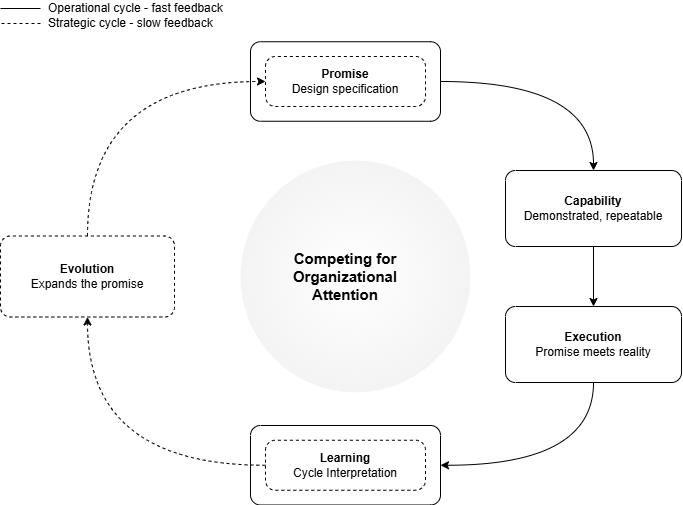
Figure 1. The Organizational Coherence Model.
The two cycles are not symmetric in importance. They are asymmetric in visibility. One dominates organizational attention by structure — not by choice.
The Asymmetry
The operational cycle has fast feedback. When execution fails, the signal arrives quickly. The organization knows something went wrong, often within days or weeks. That speed creates urgency. And urgency attracts attention.
The strategic cycle has slow feedback. When an organization stops learning from its execution — when it stops questioning whether its promise still fits the need it was designed to serve — the consequences accumulate quietly, over months and years. By the time the signal is strong enough to interpret as a problem, significant drift has already occurred.
This asymmetry is structural, not accidental.
Fast feedback systems train organizations to respond. Slow feedback systems require organizations to reflect. Responding and reflecting compete for the same finite resource: organizational attention — the cognitive bandwidth available for decision-making, coordination and strategic thought.
As organizations grow and execution scales, the operational cycle’s demand for attention grows with it. More customers mean more complexity. More complexity means more coordination. More coordination means less space for the slower, quieter work of strategic reflection.
The strategic cycle does not disappear. It is displaced.
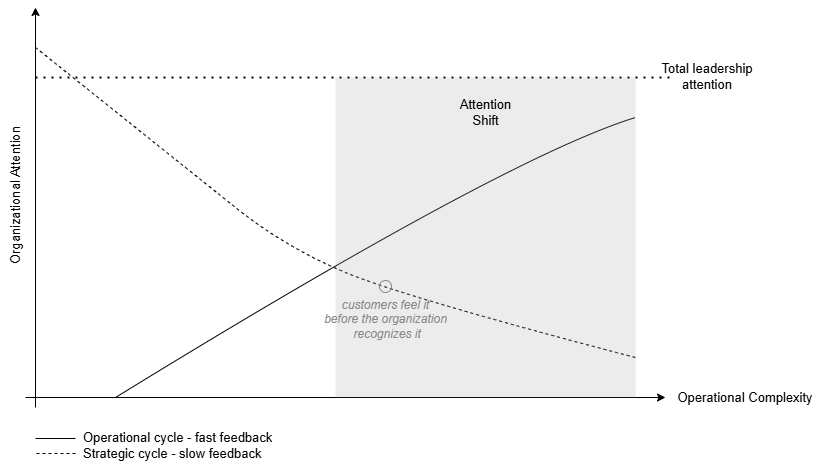
Figure 2. Coherence in Motion.
The Paradox of Operational Excellence
As the operational cycle becomes more efficient, its failures become less frequent. The feedback that once created urgency arrives less often. The organization runs more smoothly.
But the attention that operational problems once consumed does not migrate to the strategic cycle. It is absorbed by the complexity that scale produces — more markets, more products, more people, more decisions. The organization becomes more capable of executing its current promise and progressively less attentive to whether that promise still deserves to be kept.
This is not mismanagement. It is a structural tendency of systems under sustained operational pressure.
The problem is not that organizations fail to notice the strategic cycle. It is that its erosion becomes increasingly difficult to interpret as a problem. Operational metrics look favorable. Execution is consistent. The organization feels coherent. It is beginning to drift.
Customers detect this before the organization does — not through formal feedback, but through the accumulating experience of a promise that is being kept technically but no longer resonates. By the time internal indicators confirm what customers already feel, the distance is significant.
The Mechanism
The pattern is recognizable.
Growth increases operational complexity. Complexity increases the demand for organizational attention. Attention migrates toward the cycle with faster, more visible feedback. The strategic cycle loses the structural space it requires to function.
Learning from execution becomes periodic rather than continuous. The refinement of the promise is deferred — first deliberately, then by default. Evolution slows. The organization maintains coherence with its current promise while the conditions that made that promise relevant continue to shift.
The result is not collapse. It is drift.
And drift, sustained long enough, becomes the new normal. The organization stops experiencing it as distance from what it should be. It begins to experience it as simply what it is.
What This Means
Organizational coherence is not lost in moments of crisis.
It erodes in periods of operational success — when execution is strong, metrics are favorable, and the pressure to question the promise is at its lowest.
Coherence cannot be treated as a state to be achieved and maintained. It is a dynamic condition that requires deliberate effort to sustain — not only in the operational cycle, where the organization already knows how to direct attention, but in the strategic cycle, where feedback is slow, urgency is low, and the consequences of neglect arrive long after the decisions that caused them.
The question is not whether this displacement will occur. Under sustained operational pressure, it will. The question is whether the organization has developed the capacity to recognize it early enough to matter.
That capacity is not a process. It is not a framework. It is an organizational discipline — built deliberately, or absent entirely.
Part III — An Organization as Laboratory
A case in organizational coherence.
The organization described in this chapter is the one introduced in the Preface. I return to it here not because its history is unique, but because it became the environment in which the ideas presented in this essay were first observed.
The Promise
The organization was built around a specific human need: the ability of people with coeliac disease and gluten intolerance to eat safely without sacrificing the experience of food.
That need was real, underserved and poorly understood by most of the market. The dominant response at the time was elimination — remove gluten, accept the compromise in taste, texture and variety. The implicit promise most competitors were making was: safe, but lesser.
The promise this organization chose was different: safe, and genuinely good. Not a medical compromise. A real food experience that happened to be safe for people who had no other option.
That distinction was not a positioning statement. It was a design specification. It determined which ingredients were acceptable, which suppliers could qualify, which product categories made sense to enter, and which did not. It defined the standard against which every operational decision was evaluated — and the standard against which every potential compromise was refused.
The promise was narrow. It was also genuine. From the beginning, it functioned as the architectural principle described in this essay: not as something the organization communicated, but as something it was built around.
Coherence at Work
The operational consequences of that promise were visible and consistent.
Formulations that met safety requirements but compromised texture were rejected after months of development. Suppliers capable of producing larger volumes were excluded because they could not guarantee contamination standards. Commercial opportunities were abandoned because fulfilling them would have required adjusting the promise rather than expanding the capability to keep it.
These were not exceptional decisions. They were ordinary ones — made consistently, across functions, over time.
That consistency is what this model describes as operational coherence. The promise functioned as a filter. Decisions that passed through it reinforced what the organization was. Decisions that did not were refused.
Customers who found the products did not experience the usual trade-off. The promise was being kept. Internally, the organization knew what it was, and that clarity reduced the cost of decision-making at every level.
Alignment was not enforced.
It emerged.
Stability Mistaken for Maturity
What the organization could not see from inside was that operational coherence had become the ceiling, not the foundation.
The promise was clear. The product was real. The execution was consistent. That combination produced a feeling of completeness — of having built something that worked. And in a specific, limited sense, it had.
But the strategic cycle — responsible for learning from execution, questioning whether the promise was reaching the right people at the right scale, and expanding capability into new dimensions — was not operating with the same discipline.
It was not absent.
It was displaced.
The attention that organizational learning requires was being absorbed by the work of maintaining what had already been built.
The operational system had become coherent enough that it no longer generated the discomfort that drives strategic evolution.
Looking back, the pattern is recognizable. The operational cycle produced fast, legible feedback: a product that worked, customers who returned, standards that held. The strategic cycle offered slower returns — questions about commercial reach, channel development and the gap between the customers who had found the organization and the far larger population who had not.
Those questions existed.
They simply did not compete successfully for organizational attention.
I believed, at the time, that getting the product right was the condition for everything else.
It was a necessary condition.
It was not a sufficient one.
What Growth Revealed
In the final period of operation, a decision was made to invest aggressively in commercial capability — specifically in e-commerce infrastructure and marketing.
The organization responded immediately.
The channel grew 270% in twelve months.
Only then did it become clear that the architecture had been correct all along — but incomplete.
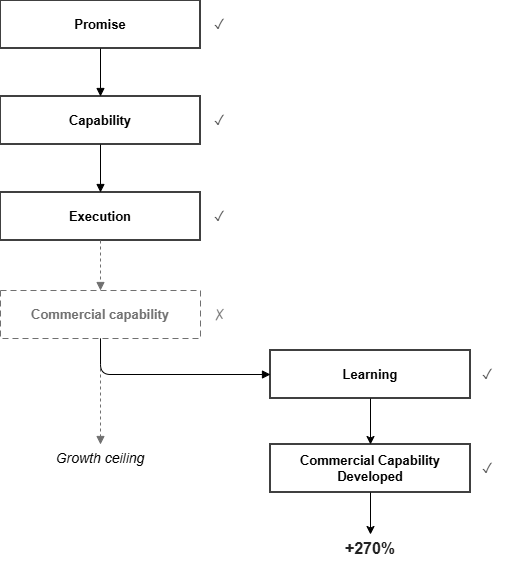
Figure 3. Capability expanded. Promise unchanged.
The promise was real. The product delivered on it. The customers who reached the organization responded to it.
What had not been built — with the same deliberateness applied to product and operations — was the capability to reach them at scale.
The growth did not emerge from a new promise or a better product.
It emerged from closing a capability gap that had existed from the beginning.
The experiment, if it can be called that, did not produce a controlled result.
It produced a clearer diagnosis.
The organization knew how to make a promise and how to keep it.
It had not developed the strategic capabilities required to expand that promise.
Commercial architecture had never been developed with the same discipline applied to product. Governance remained dependent on personal alignment rather than institutional design. Investors, partners and leadership did not share a sufficiently explicit understanding of the promise, the operating model or the time horizon that coherent growth required.
My own attention followed the same structural pattern described throughout this essay. Product demanded attention. Operations demanded attention. Quality demanded attention. Governance, commercial architecture and capital allocation generated slower feedback and therefore attracted less urgency. The cycle that most required deliberate investment was precisely the one least likely to demand it.
The organization eventually ceased operations.
The observation remained.
The system had always been capable of more than it had been designed to realize.
What the Model Explains
The pattern is not abstract when observed from inside an organization.
The operational cycle consumed attention not because it was mismanaged, but because it was working. A consistent product, a clear promise and a functioning operation generate their own gravity. They reward attention with immediate, legible feedback.
The strategic cycle offered something different: slower returns, less visible progress and questions that were harder to answer than operational problems were to solve.
The organization did not lose coherence.
It maintained coherence with a version of itself that was no longer sufficient.
That is a different kind of failure.
Coherence solved the problem of becoming the organization it intended to be.
It did not solve the problem of becoming the organization the future required.
Coherence was never the destination.
It was the condition from which the next challenge became possible.
Part IV — Coherence Under Acceleration
Every major technological shift changes how organizations execute. The current wave of artificial intelligence changes how fast they execute.
It compresses the operational cycle. Activities that once required weeks of coordination now happen in hours. Capabilities that once demanded organizational scale can be deployed by remarkably small teams. The distance between developing a capability and expressing it through execution has contracted dramatically — and that contraction shows no sign of reversing.
This changes the economics of building, the speed of iteration and the competitive dynamics of almost every market.
What it does not change is the logic that determines which capabilities are worth building at all.
What Acceleration Changes
The operational cycle has always been the faster of the two cycles described in this essay. It produces visible outputs, legible feedback and measurable results. It rewards attention with immediate returns.
Acceleration compresses that cycle further. What changes is not only speed but proximity — the gap between intention and execution has narrowed to the point where organizational scale is no longer the primary constraint on what can be built, communicated or deployed.
Artificial intelligence is the most visible expression of this compression today. It will not be the last.
The faster execution becomes, the less execution alone can explain organizational success.
What Acceleration Does Not Change
Artificial intelligence accelerates execution. It cannot choose a promise.
The questions that sit at the center of this essay remain entirely outside what any technology can resolve:
Which promise should the organization make?
Which customer needs fall outside that promise?
Which capabilities deserve investment — and which should be refused?
When has the promise drifted far enough from its original intent that it needs to be reexamined?
These are not execution problems. They are judgment problems. They require the kind of organizational reflection that belongs to the strategic cycle — the slower, more diffuse cycle that acceleration does not compress.
In fact, it makes that cycle more necessary.
The Illusion of Learning
The increase in operational velocity creates a specific illusion: that the organization is learning faster.
More is being produced. More data is being generated. More decisions are being executed at greater speed. Dashboards update in real time. Feedback loops close faster than ever before.
Yet none of this necessarily implies that the organization is becoming wiser about the promise it exists to keep.
Producing more is not the same as understanding better.
Executing faster is not the same as deciding more clearly.
The strategic cycle — responsible for interpreting what execution reveals, questioning whether the promise still fits the need it was designed to serve, and expanding capability in response — operates on a different rhythm. Acceleration does not change that rhythm. It makes the contrast between the two cycles more visible, and more consequential.
The Widening Asymmetry
Throughout this essay, the central tension has been between two cycles competing for the same finite resource: organizational attention. The operational cycle, with its fast feedback and visible outputs, consistently displaces the strategic cycle, with its slower returns and diffuse signals.
Acceleration deepens that asymmetry.
The operational cycle compresses further. The strategic cycle remains largely unchanged. The gap between them widens. The attention that strategic reflection requires becomes scarcer precisely as the demand for operational execution increases.
As execution becomes increasingly abundant, the quality of judgment becomes increasingly visible. The promise — the choice about which human need to serve, which commitments to make, and which to refuse — becomes the primary constraint in a world where execution is no longer scarce.
A well-defined promise, in a world of accelerated execution, becomes an extraordinary multiplier. An unclear one becomes a liability that compounds faster than it ever could before.
Coherence as the Constraint
The logic of organizational coherence does not change under acceleration. It intensifies.
A coherent organization that operates in an accelerated environment scales its consistency. Its promise is clear. Its capabilities are aligned with that promise. Its execution reflects both. When that system accelerates, it delivers more of what it was already doing well — faster, at greater reach, with less friction.
An incoherent organization scales its confusion. Decisions begin to outpace the capabilities that support them. Execution moves faster than the promise can sustain. Contradictions that once remained local spread across the organization before they can be understood.
The technology is identical in both cases. What differs is the system it is amplifying.
What This Means
Acceleration does not eliminate the tension between execution and evolution described in this essay.
It widens it.
By compressing the operational cycle while leaving the strategic one largely unchanged, it makes the displacement of organizational attention more likely, more rapid and more difficult to detect. Organizations that were already struggling to protect the space for strategic reflection will find that space contracting further. Organizations that had learned to sustain both cycles simultaneously will find that discipline becomes their most significant advantage.
Acceleration is, in this sense, a stress test for organizational coherence.
It does not change the logic of the system. It accelerates the consequences of whether that logic is present or absent.
Artificial intelligence does not change the logic of organizational coherence.
It compresses the time available between organizational decisions and their consequences.
Closing
Every organization described in this essay — including the one introduced in the Preface — was trying to do the same thing: keep a promise it had chosen to make, consistently, over time, under conditions that made consistency increasingly difficult.
That is not a management problem. It is the fundamental condition of organizational life.
This essay did not offer a method for achieving coherence. Methods imply repeatability — the same steps producing the same results across different organizations, different promises and different conditions. That is not what the evidence suggests.
What the evidence suggests is a pattern. Organizations that sustain coherence over time are not those that found the right process or deployed the right technology. They are those that maintained clarity about what they had promised — and continued developing the capability to keep that promise as conditions changed around them.
That clarity is not a document. It is not a strategy deck or an annual planning cycle. It is a discipline — practiced continuously, or abandoned gradually.
The central tension described throughout this essay does not resolve.
The operational cycle will always compete with the strategic one for organizational attention. Fast feedback will always be more legible than slow feedback. Execution will always feel more urgent than reflection. Coherence, once achieved, will always carry the temptation to be preserved rather than expanded.
These are not problems to be solved. They are conditions to be understood — and managed, with full awareness of what they cost when they are not.
Organizational coherence is not a destination.
It is not a state that, once reached, can be maintained through discipline and good process. It is something more demanding than that.
An organization is never finished. It is only becoming more — or less — coherent.
If that is true, then the responsibility of leadership changes as well.
It is no longer simply to improve execution. It is to preserve the conditions under which the organization can continue learning, continue evolving, and continue choosing its promise deliberately.
The purpose of organizational coherence is not to preserve what an organization is.
It is to preserve its capacity to become what its promise will require next.
Because every organization will execute.
The question is whether it will still be capable of becoming.